2026-03-05 — Ottawa-Gatineau
Adding a basement bathroom, replacing a sewer pipe, installing an interior French drain or a backwater valve: in all these cases, the concrete floor must be opened. Here's exactly how it goes, with photos from one of our real job sites.
Projects that require opening the slab
- New basement bathroom or laundry room — the classic: a trench is opened to run drain and water pipes
- Sewer pipe replacement — common in older Ottawa and Hull homes (cast iron or clay pipes)
- Interior French drain — perimeter trench against water infiltration
- Backwater valve — sometimes required or subsidized by the City of Ottawa or Gatineau
- City service connections — water or sewer
How the job site goes, step by step
1. Layout
We locate existing pipes and mark the cut lines. Precision matters: the less we open, the cheaper it is to close back up.
2. Diamond cutting
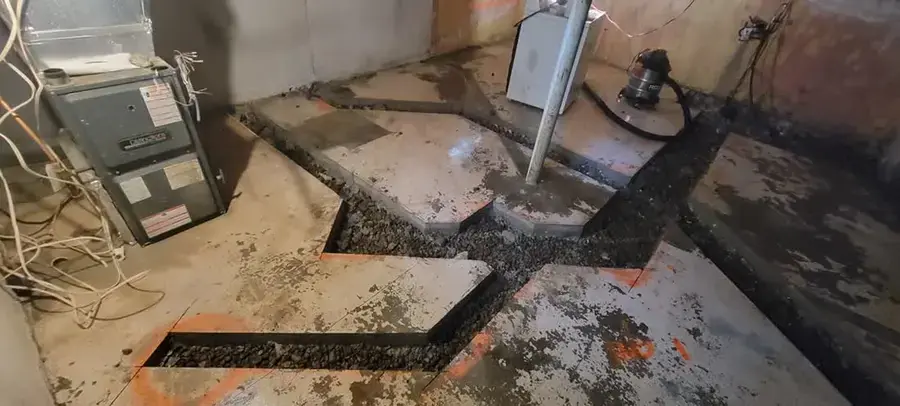
The flat saw cuts two straight parallel lines in the slab — usually 4" thick, sometimes more with rebar. Wet cutting: no dust in the house.
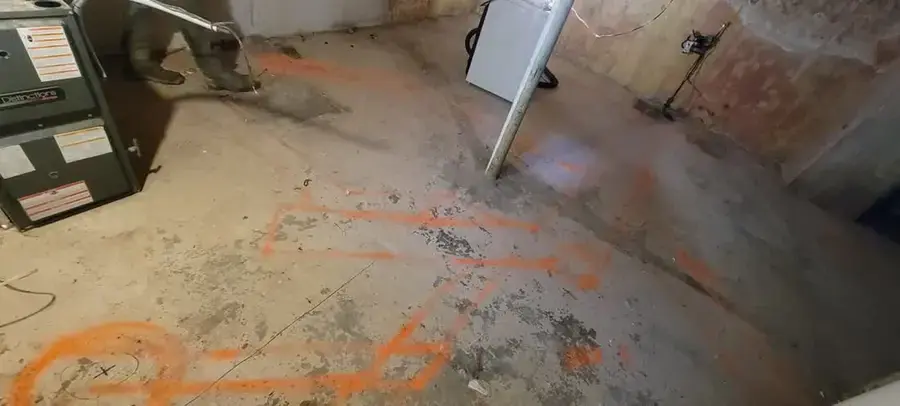 Layout before cutting
3. Breaking and excavation
We break the concrete strip between the cuts, remove the gravel underneath, and the trench is ready for the plumber.
4. Plumbing
The plumber installs the pipes — drains, sewer, water supply. On our job site below, it was a connection to city services.
5. Closing back up
Compacted gravel, then a new concrete pour to level. After a few days of curing, the floor is as good as new — ready for tile, vinyl or epoxy.
How much does it cost?
For cutting and opening a typical basement trench (plumbing and closing are billed separately). A full perimeter trench for a French drain: often $1,500 to $3,000 of cutting depending on house size.
Mistakes to avoid
- Digging without cutting first — jackhammering without pre-cutting leaves jagged edges and cracks the surrounding slab
- Forgetting to locate pipes — cutting a water line or electrical wire under the slab is expensive
- Closing before inspection — if a permit is required, the inspector must see the pipes before the pour
Typical projects that need a slab trench
- Basement bathroom — a toilet, shower and sink drain run to the main stack, usually 8 to 15 feet of trench
- Kitchen or wet bar in a basement suite — a shorter run, often combined with the bathroom
- Interior French drain — a trench around the full perimeter of the basement, connected to a sump
- Sewer line replacement — when the old clay or cast-iron line under the slab has collapsed; the trench follows the pipe out to the foundation wall
- Backwater valve installation — a short pit near the point where the sewer leaves the house, often subsidized by the City of Ottawa's protective plumbing program
How wide and how deep?
A drain trench is typically cut 18" to 24" wide, which leaves room to work beside the pipe and to compact gravel around it afterwards. Depth is dictated by the pipe: a 3" or 4" drain needs a slope of ¼" per foot toward the main line, so a long run gets deeper as it goes. The slab itself is usually 3" to 4" thick in a house; older homes sometimes have only 2", newer ones may have 5" with mesh. The cutting price depends on the total length and the thickness, not on the depth of the dig.
Before cutting: locate what is under the slab
Under a basement floor you may find the existing sewer line, the water service, a radon pipe, and in newer homes in-floor heating loops. A scan (GPR) of the trench path takes about half an hour and is worth it on any house built after 2000 or any house where the previous owner finished the basement. The plumber's drawing of the new layout should be marked on the floor before the saw arrives.
Permits in Ottawa and Gatineau
Adding plumbing fixtures requires a plumbing permit in both cities, and the inspector needs to see the drain lines in the open trench before they are covered. That means the sequence is: cut and open, plumb, inspect, then backfill and pour. Schedule the inspection as soon as the plumber is done so the trench is not left open longer than necessary.
Frequently asked questions
Can the trench be cut in a finished basement?
Yes. Flooring is removed along the trench path plus a margin, the cut is made wet, and the area is contained with plastic. The rest of the basement stays usable.
How long is the floor open?
Cutting and opening takes one day. Plumbing is usually one to two days, the inspection follows, and the pour is done the next day. A week from start to a walkable floor is typical; add a few more days of curing before tile.
Is a sump pit cut the same way?
A sump pit is a square or round opening about 18" to 24" across, cut with the same saw, then dug to the depth of the sump liner. It is often done in the same visit as a French drain trench.
Have a basement plumbing project? See our slab sawing service →